
By Brian Pate, GRI, GSI
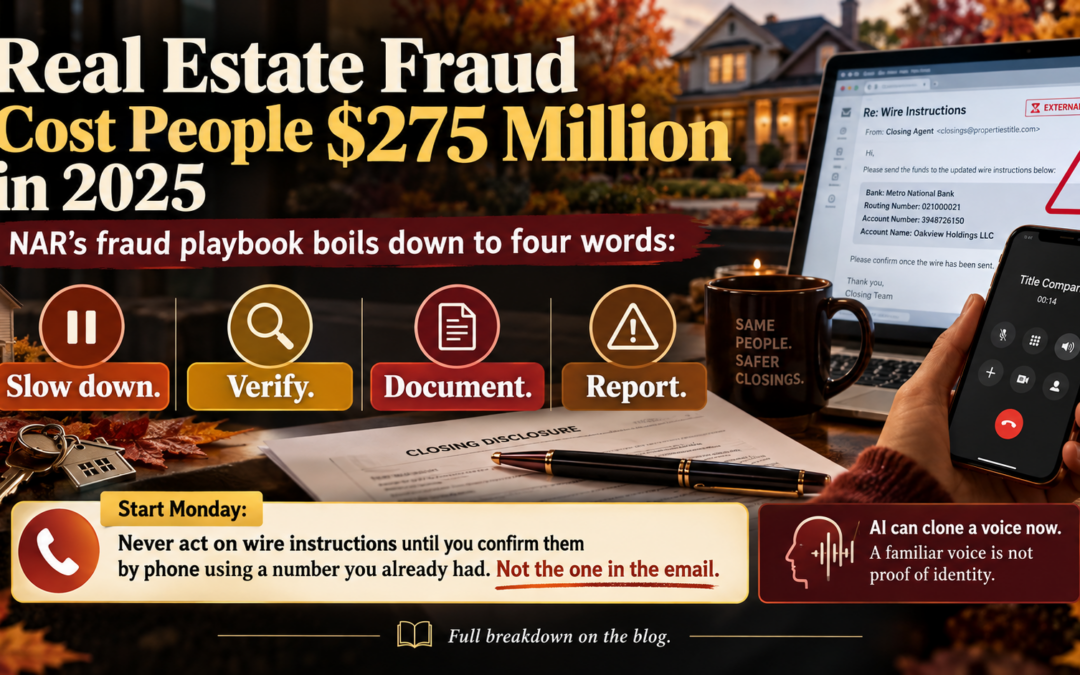
The FBI says people lost $275 million to real estate fraud in 2025. That number comes from the National Association of REALTORS®, which just put out a fraud resource built around four words: Slow down. Verify. Document. Report. I have been teaching a version of that for years. It is the best short answer I have seen.
In short:
- NAR cites the FBI’s 2025 IC3 report: $275 million in real estate-related fraud losses in 2025.
- Nearly every scheme comes down to one thing. Someone pretends to be someone they are not.
- AI makes the pretending better. NAR’s own line: a familiar voice, caller ID, email address, or text message is not proof of identity.
- The fix is a habit, not a tool. Verify through a phone number you found yourself.
Why are real estate agents such a target?
Big money. Tight deadlines. Lots of people in the loop. Constant email. And public records that tell a criminal exactly who bought what and when.
You also sit in the middle. When something feels off, your client calls you first. NAR says the same thing. That is the part that should get your attention. If you are the first call, you are also the first line of defense.
Visit Brian’s Teaching Schedule to Sign Up for Cons, Scams, and Hacks Elective (4 hours of NCREC CE)
What does the fraud actually look like?
Four things show up again and again.
- The fraudster poses as a buyer, seller, lender, title professional, attorney, or broker. Then they push you to act before you can check.
- Business email compromise. Someone gets into a real email account, or builds a near copy of one. They watch the deal. Then they send wire instructions at exactly the right moment.
- Seller impersonation. Someone claims to own a property they do not. NAR flags vacant properties and out-of-state owners for extra checking.
- AI-made proof. Cloned voices, spoofed numbers, and fake documents that look real. They get cheaper and better every month.
I open the fraud segment of Cons, Scams and Hacks with this line: if you have a computer or a cell phone, you are a target, even if you are broke. Agents are not broke. Their clients are about to wire the biggest check of their lives.
Step 1: Prevent. Slow down and verify.
Most fraud depends on speed. Urgency is the weapon. So the defense is to slow down on purpose.
Before you act on any of these, verify through a phone number you got independently of the email, text, or document in front of you:
- New wiring or money-transfer instructions
- Any change to instructions you already had
- Payment requests and closing instructions
- Identity documents and ownership claims
- Cryptocurrency wallet information
The key words are “independently of.” If the instructions came by email, do not call the number in the email. Call the number you already had, or one you looked up yourself.
NAR also flags situations that deserve extra checking:
- A vacant property or an owner who lives out of state
- A price well below market, or a seller in a big hurry to accept
- A new seller lead who will not meet, get on a video call, or verify identity
- Someone who wants everything done remotely and only talks by email or text
- Pressure to list, sell, or close fast
- An email domain that is slightly off
Do the basics too. Turn on multifactor authentication. Update your software. Use strong, unique passwords. The FBI points out that many attacks begin with a phishing email. Your inbox is the front door.
Ask your closing partner the hard questions
In North Carolina, your closing attorney is part of your fraud defense. NAR suggests asking every title, escrow, or closing provider:
- What technology and procedures do you use to prevent fraud?
- How do you verify identities, authority to act, bank accounts, and payment instructions?
- How do you send wire instructions, and how do you communicate changes?
- What secure payment options do you offer, and what safeguards come with each?
- How do you educate clients about fraud?
- Who do we call right away if we suspect fraud, and what help will you give us?
If they cannot answer clearly, find another provider. One more NAR line is worth repeating: do not assume a payment method is safe just because it is electronic.
Step 2: Detect. Know where you are in the deal.
Fraud can show up at any stage and it is rarely obvious. Often all you have is a feeling that something is not right. NAR breaks the red flags out by stage.
- Before listing: The seller will not meet, will not video chat, or will not verify identity. The ownership details do not add up.
- During the deal: A client gets odd emails asking for information. A pre-approval letter looks wrong. Wire instructions suddenly change. Messages feel out of character.
- At closing: Someone insists on an immediate transfer. Funds were sent and never arrived.
- After closing: An owner finds unauthorized title activity. A client gets an investment pitch tied to the deal.
Pay attention to that last one. Fraud does not end at the closing table.
Step 3: Report. The first few hours matter most.
If money has already left, move fast and do several things at once. NAR’s list:
- Call the sending bank right away. Ask for a fraud response and a recall or reversal.
- Tell your broker, the title or closing company, the lender, and anyone else affected.
- File a detailed complaint at IC3.gov, the FBI’s Internet Crime Complaint Center.
- Contact your local FBI field office and file a police report.
- Save everything: emails, texts, voicemails, payment instructions, and a written timeline.
- Think about calling an attorney or a qualified cybersecurity professional.
NAR is honest about the limits. Speed matters, but recovery is not guaranteed. That is the whole case for prevention.
What I would do Monday morning
- Write down your wire verification rule in one sentence. “I never act on wire instructions until I confirm by phone using a number I already had.”
- Tell every buyer and seller about it at the start, not at closing. Put it in your first meeting and your first email.
- Turn on multifactor authentication on your email today. It takes five minutes.
- Call your closing attorney and ask the six questions above.
- Brokers in charge: if your office has no written fraud procedure, write one and train your agents on it.
Notice that none of this needs new software. None of it is complicated. It is just a pause that you make a habit.
Bottom line
Most losses happen when someone acts before they verify. Most prevention starts when someone stops and asks one more question. AI is going to make the fakes better. It will not make the phone call to a number you already trust any less effective. Slow down. Verify. Document. Report.
Fake sellers are one of the featured topics in this year’s NCREC General Update. If you want to go deeper on cybercrime, scams, and how to protect your clients, that is exactly what we cover in Cons, Scams and Hacks. Check the schedule at brianpateseminars.com.
This post is general information and is not legal, cybersecurity, banking, or insurance advice. Talk to your broker-in-charge, your attorney, or a qualified professional about your situation.
Frequently Asked Questions
How much money did real estate fraud cost victims in 2025?
NAR cites the FBI’s 2025 IC3 report, which found individuals lost $275 million to real estate-related fraud that year.
What is business email compromise?
It happens when a criminal gets into a real email account, or builds one that looks nearly identical, so they can watch a transaction and send fake wire instructions or requests for information.
How do I verify wire instructions safely?
Call a phone number you got independently of the message that contains the instructions. Never use the number in the email or document itself. The FBI also recommends a secondary channel to confirm any change to wire instructions or account details.
What should I do if a client already sent money to the wrong account?
Call the sending bank immediately and ask for a recall. Notify your broker and the closing provider, file a complaint at IC3.gov, contact the FBI and local police, and keep every record. The first few hours are the most important.
Can AI really fake a voice or a phone number?
Yes. NAR notes that fraudsters can clone voices from public audio and spoof trusted phone numbers. That is why a familiar voice or caller ID is not proof of identity.
What is the single best habit to prevent real estate fraud?
Verify before you trust. Slow down, confirm by phone through a number you already had, and treat any urgency or pressure as a warning sign.
Brian Pate Seminars | brianpateseminars.com | 919-669-4575