
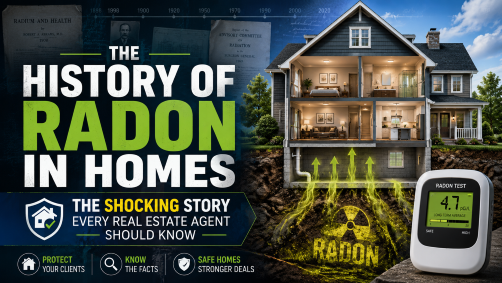
Did you know that before 1984, the real estate industry rarely tested homes for radon gas? That all changed because of a construction engineer named Stanley Watras. For real estate professionals, understanding how radon was discovered isn’t just a piece of history, it is foundational knowledge for handling modern home inspections, client safety, and property disclosures.
How Was Radon Discovered in Residential Homes?
In January 1984, Stanley Watras and his family moved into a new home in Boyertown, Pennsylvania. Watras was a construction engineer at the nearby Limerick Nuclear Power Plant. A few weeks before the plant even went online or introduced radioactive materials, radiation detectors were installed at the facility’s entrance.
Shockingly, Watras set off the radiation alarms entering the building for work.
Investigators soon realized the contamination wasn’t coming from the power plant; it was coming from his clothes and his home. While the Environmental Protection Agency (EPA) recommends action for radon levels at or above 4.0 pCi/L, the Watras home registered a staggering 2,700 pCi/L, a level higher than what is typically found inside active uranium mines.
Why Did the Watras Home Have High Radon Levels?
The Watras home was built on the Reading Prong, a geological rocky belt containing high natural concentrations of uranium. Radon gas is a colorless, odorless, radioactive byproduct of uranium decay. Looking for the path of least resistance, the gas seeped directly into the home’s interior through tiny cracks in the foundation.
The EPA temporarily took over the house to test early radon mitigation systems. They successfully brought the levels below the 4.0 pCi/L threshold, proving that even extreme radon issues can be permanently fixed.
What is Radon Gas and Why is it Dangerous?
Radon is a naturally occurring, invisible radioactive gas. According to the EPA, radon is the leading cause of lung cancer among non-smokers, responsible for roughly 21,000 lung cancer deaths per year in the United States. When inhaled, its radioactive particles break down and damage lung tissue over time, a risk that compounds significantly for smokers.
What This Means for Real Estate Professionals Today
For agents, the story of Stanley Watras highlights why radon testing is a non-negotiable step in property due diligence:
- Material Facts: Elevated radon is a health hazard and must be disclosed in real estate transactions.
- Testing is Vital: Because you cannot see or smell radon, proper testing (using short-term or long-term Alpha Track kits) is the only way to ensure safety.
- Mitigation Works: High radon levels are not a deal-breaker. Active soil depressurization systems can typically be installed for $1,000 to $2,000 to keep a home safe.
Protect your clients and stay ahead of critical property safety guidelines. Explore our upcoming real estate continuing education courses at Brian Pate Seminars.